Running short on cash three days before your salary hits the bank? You're not alone.
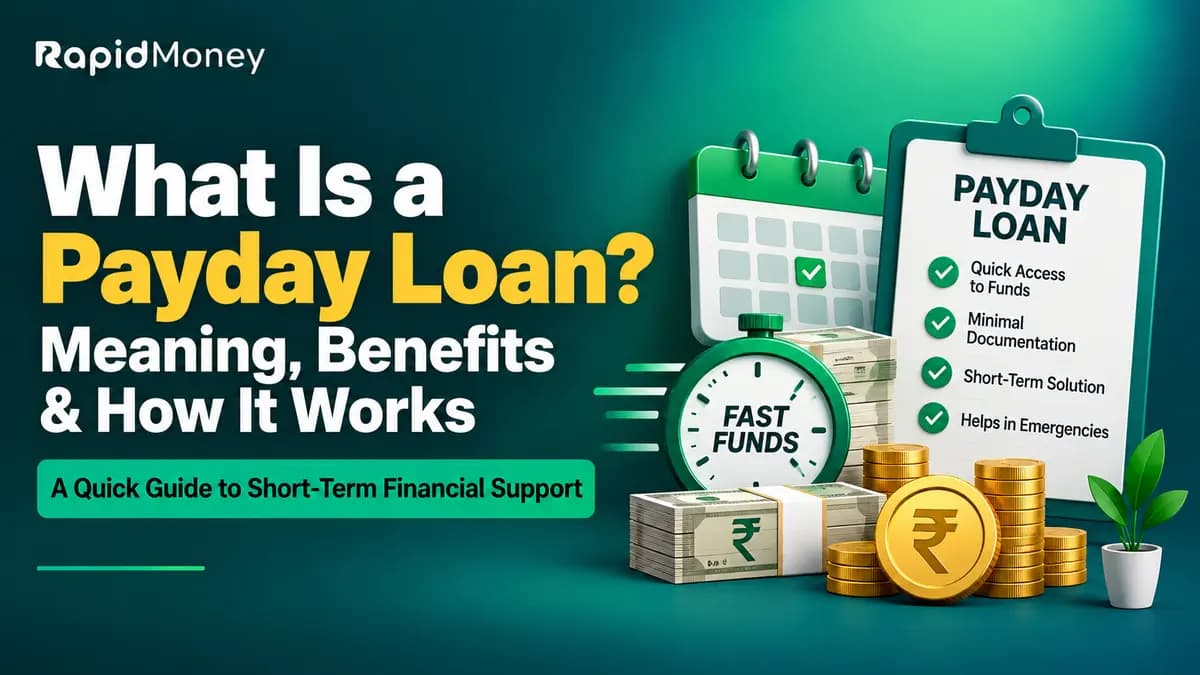
A payday loan is a short-term, unsecured loan designed to cover urgent expenses until your next salary arrives — think medical bills, an EMI you can't miss, or a utility payment that landed at the wrong time.
But speed comes with a catch: payday loans are not currently a distinct, formally regulated loan category in India, and interest rates can run far higher than a standard personal loan.
This guide explains what a payday loan is, how it works, its real benefits, and — just as importantly — where the risks lie.
A payday loan is a short term, unsecured loan – usually repaid in one payment, with interest, on or soon after your next payday.
It's also known as a micro-loan, salary advance, or instant payday loan. Because it's unsecured, you don't need to pledge any asset or arrange a guarantor.
Here's the part most borrowers miss: payday loans are not a separately licensed loan category under Indian banking law. Traditional RBI-regulated banks generally don't offer "payday loans" by name — most are issued by NBFCs or fintech apps operating as Lending Service Providers (LSPs) for a regulated lender.
That doesn't make them automatically unsafe, but it does mean you carry more responsibility for checking who's actually lending you the money.
The process is built for speed. Here's the typical journey for an instant payday loan:
Important Note: The loan is usually repaid as one lump sum, not in EMIs like a personal loan. Make sure your account has sufficient balance on the due date to avoid penalty charges.
Important Note: These benefits apply mainly to loans from credible, verifiable lenders. An unregulated app offering the same "benefits" at a lower rate is often a red flag, not a bargain.
The interest rates for payday loans are steep. Typically, payday loans come with an effective rate of around 20% to 36% per annum, making them one of the costliest short-term borrowing options available.
Eligibility criteria are fairly consistent across lenders, though exact numbers vary.
Typical Eligibility:
Pro Tip: If you’re borrowing for the first time, starting small and paying on time can boost your chances of being approved in the future by establishing a history even outside of established credit bureaus.
Payday loans are short-term loans used to cover an immediate expense until your next payday.
You apply through an app, complete e-KYC, and upload salary slips and bank statements. Once authorized you study the Key Fact Statement, sign an e-Mandate and funds are directly paid into your bank account, frequently within hours.
Payday loans offer fast disbursal, minimal paperwork, no collateral requirement, and accessibility for borrowers with a limited credit history. Usually, the interest rate is fixed for the short term of the loan.
Get your PAN, Aadhaar, salary slips and recent bank statements ready and apply through a verified app supported by NBFCs. Most approvals and disbursements occur within a few hours after the documents are confirmed.
Standard requirements are being a salaried person between the ages of 21-58 with a monthly income of at least ₹15,000–₹25,000 and an active bank account. Some lenders will also accept self-employed candidates with stable income credits.
It depends on the lender. Some NBFC-backed apps report repayment history to CIBIL or CRIF High Mark, while others don't, since payday loans aren't a uniformly regulated category — check with the specific lender.
A payday loan can genuinely help when an emergency hits and your salary is still days away — it's fast, requires minimal paperwork, and doesn't need collateral.
But because payday loans in India aren't a formally regulated loan category, the responsibility for choosing a credible lender falls largely on you. Always verify the lending NBFC, read the Key Fact Statement, and compare the annualised cost before signing.