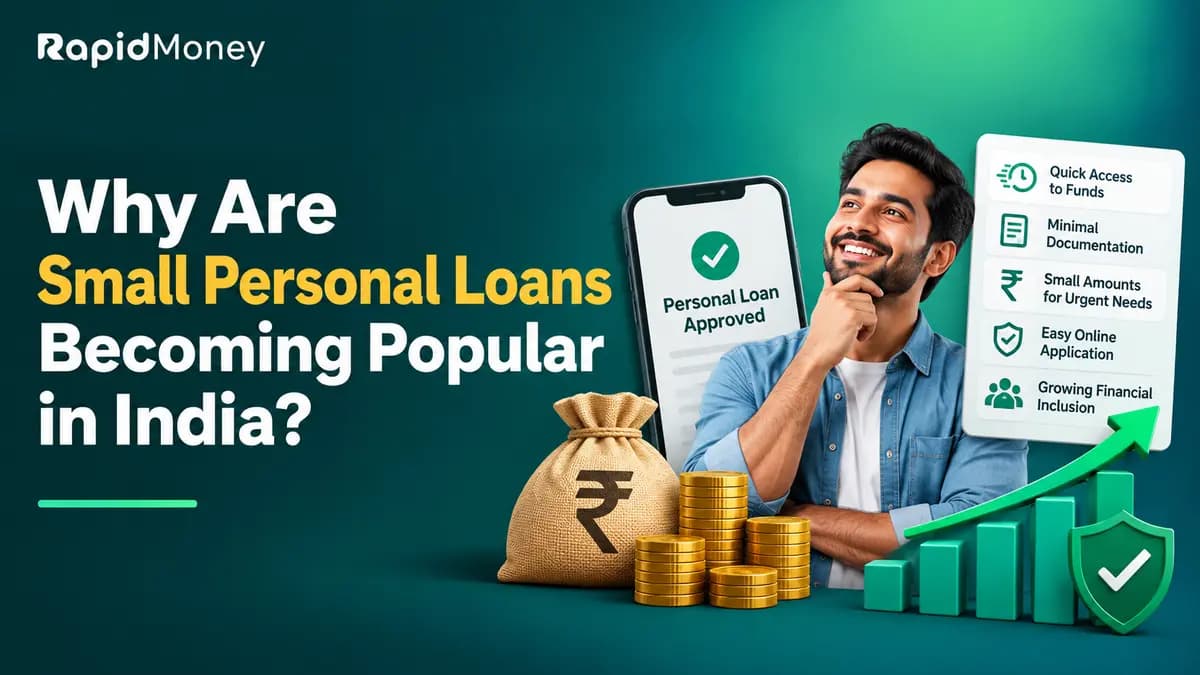
Small personal loans are becoming increasingly popular in India because they provide borrowers with access to relatively smaller amounts of money for short-term financial needs. Digital adoption has made small-ticket borrowing easier for many borrowers with fast online applications, flexible usage and access to lending services on mobile platforms.
The loan periods and loan amounts for small personal loans tend to be shorter and smaller than regular loans. These may be availed by borrowers for medical expenses, school expenses, housing expenses, utility bills, travel, emergency expenses or other planned financial necessities.
But what exactly is driving the popularity of small personal loans in India? Let's explore the major reasons.
Small personal loan is an unsecured loan of a relatively small amount. Most of the time, the borrower does not need to put up an asset as collateral.
The loan amount, rate of interest, processing fee, payback tenure and qualifying criteria may also differ based on the lender and the profile of the applicant.
For example, someone facing a temporary cash requirement may look for a loan of ₹3,000, ₹5,000, ₹10,000, ₹20,000, or another amount based on their financial requirement and eligibility.
Because these loans are usually smaller than conventional personal loans, borrowers may use them to manage specific short-term expenses instead of borrowing a larger amount than they need.
Several factors are contributing to the growing interest in small personal loans.
One of the biggest reasons is the growth of digital financial services in India.
Consumers can now discover financial products, submit information, complete verification, and manage applications online. Smartphones and widespread internet access have made digital financial services more accessible across different parts of the country.
This has changed how consumers approach borrowing.
Instead of visiting a physical branch for every financial requirement, eligible borrowers may be able to explore loan options through digital platforms.
But borrowers should always check the lender or lending service provider, comprehend the terms and conditions and check the overall cost of borrowing before accepting an offer.
Not every financial requirement involves a large amount of money.
For example, an individual may need a few thousand rupees to manage an unexpected household expense or another short-term financial requirement.
A small personal loan can potentially address a specific funding gap without requiring the borrower to apply for a substantially larger loan.
This is particularly relevant when the borrower has a clearly defined expense and a repayment plan.
Convenience is another important factor behind the popularity of digital personal loans.
Many online lending platforms allow borrowers to begin the application process from a smartphone or computer.
Depending on the provider, the process may involve:
The exact process differs between lenders and loan service providers.
India has experienced significant growth in smartphone and internet adoption.
This has created a larger digital audience for financial services, including banking, payments, insurance, investment platforms, and digital lending.
Consumers who are already comfortable using mobile applications for UPI payments, shopping, banking, and bill payments may also find online financial applications more familiar.
As digital financial behaviour expands, online loan discovery and application processes have become more visible to consumers.
A personal loan is generally different from a purpose-specific loan such as a home loan or vehicle loan.
Depending on the lender's terms, borrowers may use a personal loan for various legitimate personal expenses.
Possible uses can include:
Borrowers should check the specific terms of the loan before using the funds.
Unexpected expenses can create temporary financial pressure.
For instance, an urgent repair, medical expense, educational payment, or household requirement may arise before the next salary arrives.
When savings are insufficient, some consumers may consider borrowing.
Small personal loans can therefore be relevant to people looking for a relatively small amount to manage a short-term financial requirement.
However, borrowing should not be treated as a substitute for emergency savings. Consumers should consider whether they can comfortably repay the loan before applying.
A small personal loan may be considered by eligible borrowers who have a temporary financial requirement and a reasonable repayment plan.
Potential borrowers may include:
Eligibility criteria differ significantly between providers.
Lenders may look at things like your income, employment profile, credit history, existing liabilities, age, geography and other information when assessing you.
Therefore, simply meeting one eligibility condition does not guarantee loan approval.
Borrowers should be aware that qualifying criteria of the lender are subject to approval before applying.
Common factors can include:
A stable and sufficient income can be an important consideration because it indicates the borrower's ability to repay the loan.
The lender could take into account your credit history when making a decision. A better credit profile is helpful, but lenders may have various requirements.
Existing EMIs and other financial obligations can affect affordability.
If you have many loans going, think long and hard about whether you can afford another monthly payment.
Lenders may assess employment or income stability depending on their underwriting policies.
The most crucial thing for borrowers to evaluate is if they can repay the loan easily as per the agreed payment plan.
Small personal loans can offer several potential benefits when used responsibly.
Digital lending platforms may simplify the application process and reduce the need for physical paperwork, depending on the provider.
Personal loans are commonly unsecured, meaning borrowers generally do not need to pledge an asset as security.
If you can, borrow less than you need so you don’t borrow more than you need.
Applications can often be initiated online, making the process convenient for consumers who prefer digital financial services.
Depending on the lender's terms, personal loan funds may be used for different personal expenses.
The convenience of online borrowing should not replace careful financial evaluation.
Before accepting a loan, check the following:
Understand the applicable interest rate and whether it is calculated on a reducing or other basis according to the loan agreement.
Don't look only at the advertised interest rate. Take into account the whole cost of borrowing including fees and charges.
Some lenders may charge a processing fee. Check whether it is included in the amount disbursed or charged separately.
Understand the loan tenure and repayment frequency.
A shorter tenure may result in higher periodic payments, while a longer tenure may increase the overall interest cost.
Read the agreement to understand what happens if an EMI or repayment is missed.
If you want to pay off the loan early, check for any fees or limitations that apply.
Always verify who is actually providing the credit.
If a digital platform acts as a loan service provider or lending service intermediary, borrowers should understand its relationship with the actual lender.
Small personal loans can be legitimate financial products, but borrowers should verify the provider and carefully review the loan agreement before borrowing.
Consumers should be cautious of platforms that:
Before you proceed, check the name of the lender, the terms offered to you, privacy information, fees and charges, payback schedule and specifics of grievance-redressal.
For digital lending in India, borrowers should also understand the applicable regulatory framework and review the RBI's guidance on digital lending and borrower protections before proceeding. RBI Digital Lending Guidance
The primary difference is generally the amount and borrowing requirement rather than the fundamental concept of personal credit.
The exact features vary by lender.
Responsible borrowing starts with understanding affordability.
Before you apply, calculate your monthly income and essential outgoings. Then, check your existing EMIs and see if the proposed amount for repayment is something that you can easily afford within your budget.
A simple process is:
Income → Essential expenses → Existing EMIs → New repayment → Remaining disposable income
If the new repayment leaves insufficient money for essential expenses, borrowing may increase financial pressure.
It is also important to avoid taking multiple loans simply to repay existing loans unless you have carefully evaluated the total cost and repayment implications.
Responsible borrowing starts with comparing the total cost and borrowing only what you can comfortably repay. You can also read these smart ways to borrow a personal loan before applying.
In general, small personal loan are unsecured loans with a relatively little sum of money borrowed. Depending on the lender's rules it is usable for personal expenses qualifying.
Rising digital adoption, smartphone usage, online financial services, ease and desire for short-term funding options are linked to their popularity.
Some lenders and digital lending platforms offer online application processes. Eligibility, documentation, approval, and disbursal depend on the provider.
Requirements vary, but lenders may request identity, address, income, employment, and bank-related information. The exact documentation depends on the lender.
Many personal loans are unsecured, so collateral may not be required. However, borrowers should confirm the specific terms of the loan they are considering.
Credit history can be one factor in lending decisions, but eligibility criteria differ among lenders.
No. Borrowers should consider their income, existing debt, repayment capacity, and the total cost of the loan before applying.
India's financial ecosystem is becoming increasingly digital. Digital borrowing is also becoming more evident as people get more accustomed with online banking, digital payments and app-based financial services.
Small personal loans will continue to be useful for customers that need relatively small sums of money for certain financial purposes. But ethical financing and well-informed borrowing are still critical.
Consumers should focus on more than just how quickly they can receive money. The interest rate, total cost, repayment period, lender identity, fees, data practices, and repayment obligations should all be considered.
Small personal loans are becoming popular in India because they can provide a convenient way to address relatively small, short-term financial requirements. The reason for their growing prominence is the use of digital applications, the take-up of smartphones, flexible usage and the spread of online financial services.
However, convenience should not be confused with affordability. Borrowers should analyze the overall cost, understand the repayment schedule, verify the lender or lending arrangement, and ensure that the EMI fits comfortably within their budget before accepting a small personal loan.
A small loan can solve a temporary financial requirement, but responsible borrowing means taking only what you can reasonably repay.