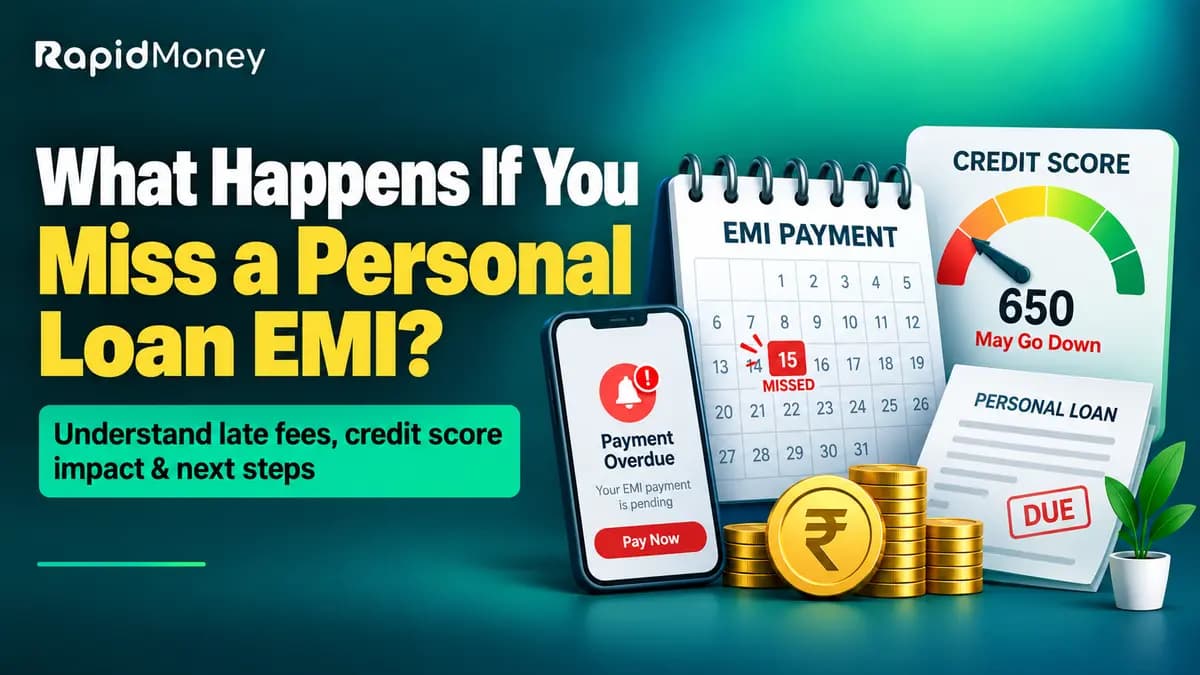
Missing a personal loan EMI can happen because of an unexpected expense, salary delay, medical emergency, or insufficient bank balance. However, even one missed payment can create additional costs and affect your credit history.
If you have missed an EMI, do not panic. The important thing is to understand what happens next, how to manage the overdue payment, and what steps you can take to avoid further problems.
In this guide, we explain the consequences of missing a personal loan EMI, possible late payment charges, the impact on your CIBIL score, and practical steps to manage repayment.
When you take a personal loan, you agree to repay the borrowed amount through monthly instalments called Equated Monthly Instalments (EMIs). Each EMI generally includes a portion of the principal amount and interest.
If you fail to pay an EMI by its due date, the payment becomes overdue. Depending on your lender's terms and the circumstances, you may face the following consequences:
What happens depends on how long the payment is delayed, your loan agreement and your lender’s regulations. Missing an EMI does not mean that your loan is automatically terminated or that legal action will start immediately.
Every lender will have a different process, but here is a schedule that borrowers may expect.
Your lender attempts to collect the scheduled EMI through your selected repayment method, such as an auto-debit mandate or another payment option.
In case the payment fails due to inadequate amount, technical problem or other reasons, check the status on your bank statement and loan account.
Your lender may send an SMS, email, app notification, or other communication reminding you about the overdue amount.
Applicable late payment charges or failed-payment charges may also arise, depending on your loan terms.
Contact your lender to confirm the amount due instead of assuming that the original EMI is the only amount you need to pay.
If you do not clear the overdue amount, the lender may continue sending reminders and contacting you about repayment.
Your overdue status may also be reported to credit bureaus according to You may also be reported to credit bureaus for your overdue status in accordance with appropriate reporting rules. This can influence your credit history and future borrowing options.
Continued non-payment may result in more significant penalties, including further collection efforts and possible legal recovery proceedings.
For applicable bank loans, an account may be classified as a Non-Performing Asset (NPA) when it meets the relevant regulatory criteria. The 90-day overdue rule is relevant for many ordinary bank loan accounts, however classification will rely on the applicable rules and conditions of the account.
Do not wait until your account becomes seriously overdue before contacting your lender.
Missing an EMI may result in additional charges. However, there is no single late payment fee that applies to every personal loan in India.
The amount depends on your lender, loan agreement, and the nature of the payment failure.
A lender may levy costs if an EMI is not paid by the due date as promised.These charges and their calculation method should be explained in the applicable loan terms.
If your EMI is collected through an automatic debit and the transaction fails, your bank or lender may apply a payment-return or bounce charge, depending on the applicable terms.
For example, a failed NACH or auto-debit transaction may result in a charge from the bank, the lender, or both, depending on the arrangements.
Penal charges may occur according on the applicable loan terms if you don’t meet your repayment commitments.
Borrowers should check how these charges are calculated, when they apply, and whether they are separate from regular interest or other fees.
Yes, missing a personal loan EMI can affect your CIBIL score and credit history, particularly if the payment remains overdue and is reported to the credit bureau.
Your credit report may contain information about your repayment history, including whether payments were made on time or were overdue.
However, the exact effect on your score is not the same for every borrower.
It can depend on factors such as:
There is no reliable universal rule that says missing one EMI will reduce everyone's CIBIL score by a fixed number of points.
Not necessarily.
Paying the overdue amount can bring your account up to date, subject to the lender's processing and account status. However, an accurately reported late payment may remain part of your credit history even after you have paid.
Regular on-time payments over time can help create a positive repayment pattern. If there’s an error on your credit report, you can dispute it with the credit agency in question, and reach out to your lender to request a repair.
Missing multiple consecutive EMIs can make repayment more difficult because the overdue amount increases and additional charges may apply.
Here are some possible consequences:
You might have to pay a few overdue instalments with relevant costs. This can place further pressure on your monthly budget.
Missed payments can indicate a lack of ability to manage credit responsibilities and can influence lenders’ opinions on future loan requests.
Your lender may contact you more frequently about the outstanding dues and repayment arrangements.
When evaluating a new loan application, lenders typically look at repayment history and ongoing liabilities. Therefore, a history of frequent missing payments can damage your eligibility or the terms you are offered.
If you have missed two or three EMIs, contact your lender as soon as possible and ask about the total overdue amount and available repayment options.
If a personal loan remains unpaid for a prolonged period, the consequences can become more serious.
For many ordinary bank loan accounts, 90 days overdue is an important threshold under the NPA classification methodology in use. But exactly how depends on the type of lender, the applicable legislation, and the circumstances of the account.
Possible consequences of prolonged non-payment include:
A 90-day overdue period should not be treated as a universal deadline for legal action. Nor does missing an EMI automatically mean that a borrower will face criminal prosecution.
If you have already missed an EMI, taking action early can help you understand the situation and avoid additional overdue payments.
Confirm whether the EMI was actually deducted. Sometimes, a payment may be delayed or may appear differently in your bank statement.
If the transaction failed, check whether the reason was insufficient balance, a mandate issue, or a technical problem.
Ask your lender to confirm:
If you are able to afford the payment, clear the overdue amount using a lender-approved method.
Keep the receipt or transaction reference and check that your loan account reflects the payment correctly.
If your financial situation makes repayment difficult, contact the lender before missing additional instalments.
Depending on your situation and lender policy, you may have the chance to discuss options such as a revised repayment arrangement or restructuring. Not all of the options are available to everyone and there can be cost implications of these choices.
Ask for any revised terms in writing before agreeing to them.
After the lender has processed your payment and the relevant reporting cycle has passed, review your credit report.
If you notice an incorrect overdue status or payment entry, contact the lender and raise a dispute with the relevant credit bureau.
Remember that accurate late-payment information is not necessarily removed just because the overdue amount has been paid.
It may still be possible to obtain a personal loan after missing an EMI, but approval is not guaranteed.
Lenders may consider several factors, including:
If you have missed an EMI, focus on bringing your existing account up to date and making future payments on time.
Avoid applying for multiple loans simply to cover an overdue EMI without understanding the costs and repayment obligations of the new borrowing.
A few practical habits can help you manage your loan repayments more consistently.
Set a reminder a few days before the EMI due date so you have time to check your account balance.
Keep enough money in your repayment account before the scheduled debit date. Consider other automatic payments that may reduce your available balance.
Auto-debit can make repayment convenient, but it is still important to check whether the transaction was successful.
When possible, build up savings for emergencies or temporary loss of income. Every little bit helps lower the chance you’ll miss a payment.
Before taking a loan, consider your monthly income, essential expenses, existing debt, and other financial commitments.
Estimate your monthly EMI with a personal loan EMI calculator and see how different loan amounts and tenures impact your repayment.
Your EMI may become overdue and late payment/ bouncing charges may be imposed. If the missed payment is recorded by the lender, it could also harm your credit history.
It could. The impact depends on your credit profile, the length of time the payment is overdue, and the information given by your lender. There is no universal score lowering for all borrowers.
Depending on the terms of your loan, you may be able to make a late payment using a lender-approved method. Call your lender to verify the amount outstanding and any charges that apply.
Your overdue amount can be increased with additional charges being applied. Your payments history could be further damaged. Contact your lender immediately to discuss repayment.
If the entry is inaccurate, you can raise a dispute and request correction. Accurate late-payment information is not automatically removed simply because you have repaid the overdue amount.
Missing a personal loan EMI can lead to overdue costs, repayment follow-ups, and possible impacts on your CIBIL score and future borrowing prospects. The consequences depend on your loan terms, the duration of the delay, and your lender's policies.
If you have missed an EMI, check your account, contact your lender, confirm the amount due, and make a repayment plan that fits your financial situation.
Most importantly, do not ignore missed payments. Early communication and consistent repayment habits can help you manage your existing loan and work toward a healthier credit history.